
 |
|||
 |
Home |
Catalogs |
Contact Us |


Books on:
Animal RightsBlack History
Clean Energy
Democracy
Eco Design
Eco History
Food and Nutrition
Genetic Engineering
Green Cities
Green Politics
Local Economics
Natural Building
Peace and Nonviolence
Simple Living
Trees and Forests
Vandana Shiva
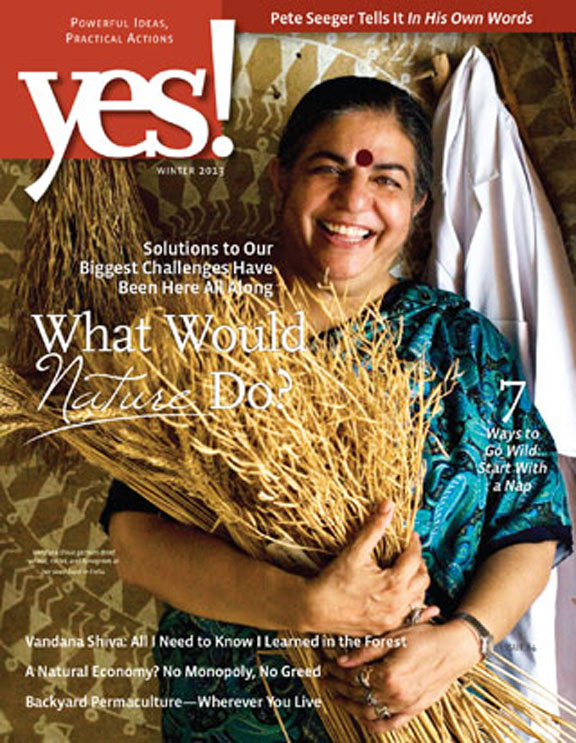 YES! Magazine, Winter 2013, Everything I Need to Know I Learned in the Forest |
"The primary threat to nature and people today comes from centralising and monopolising
power and control. Not until diversity is made the logic of production will there be a
chance for sustainability, justice and peace. Cultivating and conserving diversity is no
luxury in our times: it is a survival imperative."
— Vandana Shiva
Vandana Shiva is a burst of creative energy and intellectual power."--The Progressive
"One of the world's most prominent radical scientists."--The Guardian
"The South's best known environmentalist."--New Internationalist
"A leading thinker who has eloquently blended her views on the environment, agriculture, spirituality, and women's rights into a powerful philosophy."--Utne Reader
"Shiva has devoted her life to fighting for the rights of ordinary people in India. Her fierce intellect and her disarmingly friendly, accessible manner have made her a valuable advocate for people all over the developing world."--Ms. Magazine
Vandana Shiva is one of the world's most dynamic and provacative thinkers. Born in India in 1952, she trained as a physicist at the University of Western Ontario in Canada. At the Indian Institute of Science and the Indian Institute of Management in Bangalore, India, she did research in science, technology and environmental policy. In 1982, she set up the Research Foundation for Science, Technology and Natural Resource Policy in her home town of Dehra Dun in the foothills of the Himalaya. The foundation's studies have validated the ecological value of traditional farming and have been instrumental in fighting destructive development projects in India.
Among Dr. Shiva's many awards are the Right Livelihood Award in 1993, the Order of the Golden Ark, Global 500 Award of the UN, Earth Day International Award, the Lennon Ono Grant for Peace and the Sydney Peace Prize 2010. Time Magazine identified Dr. Shiva as an environmental “hero” in 2003, and Asia Week has called her one of the five most powerful communicators of Asia. She serves on the boards of many organizations, including the World Future Council, the International Forum on Globalization and Slow Food International.
Her books include:
- Earth Democracy: Justice, Sustainability, and Peace
- Stolen Harvest: The Hijacking of the Global Food Supply
- Biopiracy: The Plunder of Nature and Knowledge
- Soil Not Oil: Environmental Justice in an Age of Climate Crisis
- Staying Alive: Women, Ecology, and Development
- Ecofeminism with Maria Mies
- Water Wars: Privatization, Pollution And Profit
From the Right Livelihood Award Profile of Vandana Shiva
http://www.rightlivelihood.org/v-shiva.html
Shiva's record has been that of the totally committed, very productive and effective activist-advocate-intellectual. As an activist she has co-ordinated, supported and learned from grassroots networks on a wide range of issues across India. As an advocate, especially in international fora, she has proved one of the most articulate spokespersons of counter-development in favour of people-centered, participatory processes. As an intellectual she has produced a stream of important books and articles, which have done much both to form and address the agenda of development debate and action.
Her foundation is an informal network of researchers, working in support of people's environmental struggles, part of the objective of which is the articulation and justification of people's knowledge. The foundation has done important work in a number of areas, including:
* Agriculture and genetic resources. Shiva's critical analysis of the effects of the Green Revolution, and looking beyond it to the impacts of the 'second' Green Revolution powered by genetic engineering, is of pioneering importance. For more than 15 years, she has been a campaigner on the ethical and ecological impacts of genetic engineering. She has led campaigns on bio-safety and built citizens' responses to the introduction of genetically modified organisms (GMOs) in agriculture.
* Biodiversity. She started her work on biodiversity with the Chipko Movement in the 1970s. As with forestry and water, her contribution has gone beyond critique with the launch of a 'people's programme on biodiversity'. She has pioneered the organic movement in India and has built a new movement called Navdanya, the country’s biggest network of seed keepers and organic producers, for the conservation of indigenous seeds. Shiva sees biodiversity as intimately linked to cultural diversity and knowledge diversity. She has campaigned nationally and internationally against 'biopiracy' - the patenting of indigenous knowledge. Her book on the subject, Biopiracy, deals with the emerging corporate monopolies on the living resources of the poor.
* World Bank and WTO Campaigns. Shiva has been an important figure in putting pressure on the World Bank, which the Bank has been forced to take increasingly seriously. She represented 'Nature' at the People's Tribunal on the World Bank and IMF in Berlin in 1988 and was on the steering group of the People's Forum, which coincided with World Bank meetings in 1991. Shiva has also initiated major movements in India on World Trade Organisation (WTO) issues, especially on intellectual property and agriculture. She is a founding Board member of the International Forum on Globalisation, the citizens' group dedicated to monitoring and intervening on the impact of globalisation. She is currently leading an International Campaign on Food Rights, for people's right to knowledge and food security.
* Ecology and gender. Her book Staying Alive: Women, Ecology and Survival (Zed, 1989) has had an international impact. She was a co-chair of the 1991 World Congress on Women and Environment, and she directed a dialogue on 'Women, ecology and health' with the Dag Hammarskjold Foundation, leading to a volume of Development Dialogue edited by her. Shiva has launched a global movement called Diverse Women for Diversity, for the defence of biological and cultural diversity.
Reader Comments |
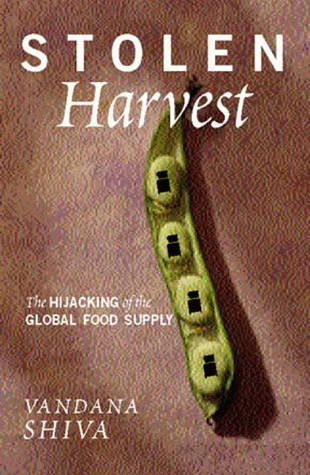
Stolen Harvest by Vandana Shiva
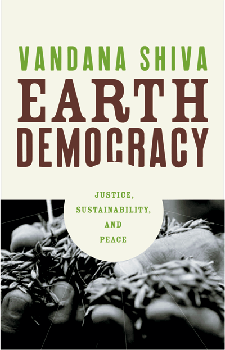
Earth Democracy by Vandana Shiva

Biopiracy by Vandana Shiva